Newsletter Subscribe
Enter your email address below and subscribe to our newsletter

Enter your email address below and subscribe to our newsletter

Is there a story writers love to tell more than the one about how we became ourselves? Give me all of them: Your künstlerromans, your campus novels, your NYCs, your MFAs. I didn’t go to Iowa, but I’ve read so many recollections of the program that sometimes I think I might have. The pleasures of the genre arise in part from how its entrants play with certain tropes: the struggle to find one’s voice, the anxiety of influence, the labor of constructing an identity, the implicit resolution promised by the book the reader holds in their hands.
A key figure in this artistic coming-of-age is the charismatic teacher. The writing teacher is both a vision of a possible future and that future’s arbiter; maybe the first authority to give—or withhold—permission for the student to keep going. The stakes of their pleasure or displeasure are high. This can make it easy to confuse the aim of the class—to write good sentences—with the teacher’s gratification. A good teacher, writes Amia Srinivasan in The Right to Sex, will get out in front of this confusion, seizing a student’s desire and rerouting it toward its proper object: their education. You could fill a bookshelf with examples where that redirection fails, and the ensuing lessons confer an aesthetic and moral education of an entirely different kind.
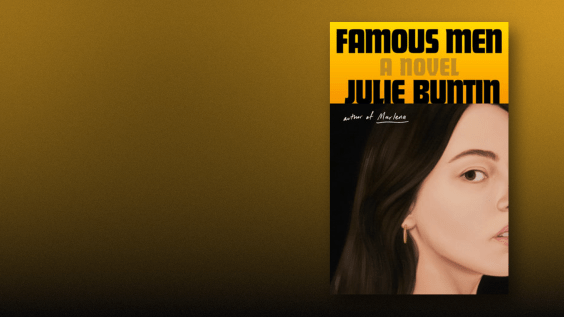
Julie Buntin’s sophomore novel, Famous Men, is an audacious entry into this canon. The narrator is Wilhelmina (Will) Miles, a budding writer from Greening, a fictional town in Northern Michigan. Greening’s best-known export is the “great American writer” Nathaniel Fellow, who teaches at a prestigious MFA program in New York. When Will discovers his poetry at 14, it dilates her sense of what life and art might look like. In Greening of the early aughts, a world of snow and skinned deer, of “raw-eyed fathers and their identical boys,” she feels constrained—by tensions with her mother; her mother’s predatory boyfriend; a high-school rumor that dogs her after a party; her longing for proximity to art. Her hunger to escape takes Nathaniel as its object—not just his work, but the chance that he might be the father whose identity her mother has never revealed. By the time she finally makes it to his doorstep in her early 20s, his influence and her artistic formation have been intertwined for a substantial portion of her life.