Newsletter Subscribe
Enter your email address below and subscribe to our newsletter

Enter your email address below and subscribe to our newsletter

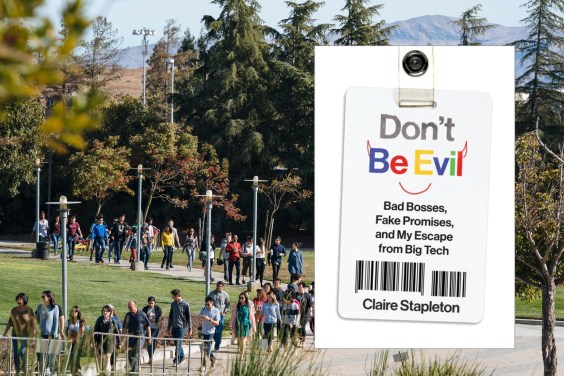
It feels a little perverse to be writing this review in a Google doc. In 2018, over 20,000 Google employees walked out to protest working conditions at the tech juggernaut. Claire Stapleton was one of the protest’s primary organizers. She had started at the company as an internal communications associate, drafting copy to explain the work product of the company to actual employees. Her quippy emails earned her multiple promotions and even the internal moniker “Bard of Google.” After a few years, however, Stapleton, along with many other employees, were fed up with the sexism, racism, and intense hierarchy of the company. Andy Rubin, who was accused of extensive sexual harassment, had received a $90 million exit package from CEO Larry Page. Many Black employees were underpaid and many women were exhausted by the boy’s club environment. New York magazine wrote an extended oral history of the highly publicized event. Almost a decade later, Stapleton has published an account of her turbulent time in labor organizing, titled Don’t Be Evil: Bad Bosses, Fake Promises, and My Escape from Big Tech.
What starts as a straightforward memoir eventually evolves into a reckoning. Can you work in tech without losing your morals? The epigraph of the book is from Graham Greene: “Sooner or later, one has to take sides. If one is to remain human.” The problem, Stapleton realizes, is that while Google claims to have principles, it’s a big company like any other, prone to power plays and the bottom line. “It was half utopia, half dystopia, and somehow completely unable to tell the difference,” she writes. Perhaps even worse: “It was the kind of evil that doesn’t even realize it’s evil.”
Stapleton’s older brother Scott, who died early on in her career, was one of the first to call Google a cult even as she began to rise through the ranks. His passing highlighted the way her sense of self had been warped by the corporate world. After helping send out an email announcing her brother’s death, she realized that she “had become someone who managed my life like I was in a permanent performance review.” Her friend noted that “people wanted to see you perform a productive version of grief.”