
Newsletter Subscribe
Enter your email address below and subscribe to our newsletter

Enter your email address below and subscribe to our newsletter

Various journalists have tried and failed to investigate the origins of turducken, that matryoshka-inspired dish of a chicken nested inside a duck nested inside a turkey. One chef in Louisiana claims to have invented the dish but refused to tell the New York Times when or where he created it, or even his age. But turducken is best understood as a modern combination in an ancient lineage of engastration, a cooking technique in which one animal is stuffed inside another.
Other famous entrants in the genre include haggis, a potpourri of sheep organs stuffed inside its stomach, and kiviak, a wintertime Inuit dish made of little auks that ferment inside sealskin. The most ostentatious engastration may well be Alexandre Balthazar Laurent Grimod de La Reynière’s rôti sans pareil, or “roast without equal,” which called for “a bustard stuffed with a turkey, a goose, a pheasant, a chicken, a duck, a guinea fowl, a teal, a woodcock, a partridge, a plover, a lapwing, a quail, a thrush, a lark, an ortolan bunting and a garden warbler.”
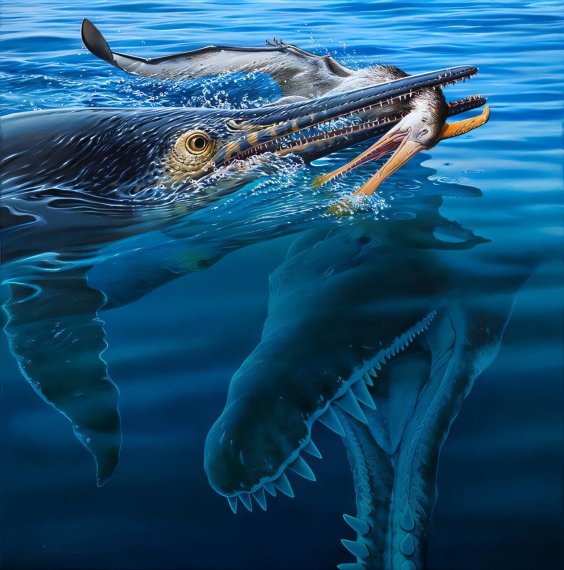
In nature, however, engastration is simply a way of life. To swallow someone whole often also involves swallowing whoever they recently swallowed. Scientists recently discovered an exemplar of this all-natural turducken from around 100 million years ago in the Cretaceous. The recipe is as follows: Stuff some early cephalopods inside a flying reptile called a pterosaur, then stuff that pterosaur inside a marine reptile called an ichthyosaur. As a garnish, feed part of the ichthyosaur to an even larger marine reptile called a pliosaur. The fossil was found in Queensland, in what was once the shallow Eromanga Sea, and described in the journal Gondwana Research.