Newsletter Subscribe
Enter your email address below and subscribe to our newsletter

Enter your email address below and subscribe to our newsletter

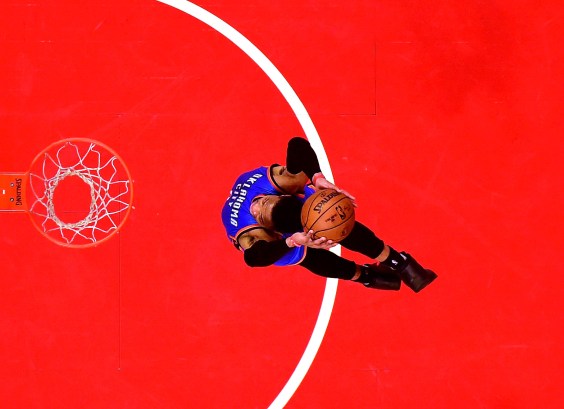
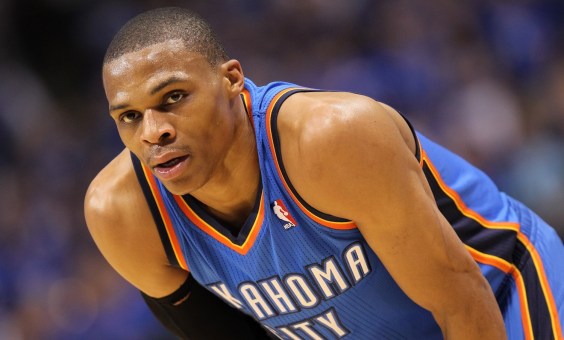
It’s hard to imagine now—like imagining an era when man did not know the sun was huge, hot, and bright—but there was a time when we did not yet understand Russell Westbrook as a basketball player. Slow to hit his growth spurt, Westbrook didn’t dunk until his senior year of high school. Coming out of UCLA after his sophomore year, he was hailed as a defensive stud, with unexplored skill offensively; he still mostly played off the ball. Envision, if you can, an adult Russell Westbrook who had already given over his life to basketball, but did not yet dunk and did not yet dominate the ball. It makes me feel a little insane, like it’s never too late to carve out the defining traits of your life. Go out and remake yourself tomorrow, then decide that that’s you from here on out, and then don’t quit for 18 years. That’s what Westbrook did, before announcing his retirement on Wednesday, throughout 18 years of uncompromising, rock-headed, glorious self-actualization.
Westbrook entered the NBA in 2008, at the same time as the Oklahoma City Thunder franchise. He helped form a molten triple-future-MVP core that arrived at the 2012 NBA Finals, before coming apart piece by piece. James Harden left that offseason, where he pursued his own, slightly more sluggish, ball-dominant destiny in Houston. That ushered in the “your turn, my turn” era with Westbrook and Kevin Durant, only for KD to defect to the Californian enemy in 2016. First there were three, then there were two, and then there was only Russell Westbrook. Again, it’s hard to imagine him any other way. Left to his own devices he began important investigations into the very structure of basketball. How much can one man do? How much of an ostensible “team” sport can we instead funnel through the willpower and fast-twitch muscles of one tireless and pissed-off man? He answered these questions with his performances: the coast-to-coast dunks, the 20-20-20 game, the triple-double average MVP season, the carry job to end all carry jobs. He was a perpetual motion machine.
What it looked like, when it was good: hurling himself headlong at the rim, over and over, with bone-rattling fury and apparent disregard for his own welfare. What it looked like, when it was bad: hurling himself headlong at the rim, over and over, with bone-rattling fury and apparent disregard for his own welfare. There was only ever one true way to be Westbrook, and his mere presence on the hardwood colonized every aspect of game play. A little like Vonnegut’s ice-nine, once he touches the ball, the whole floor becomes instantly Westbrookized. Everyone else slots into their tidy supporting roles. Big man: set screens hard enough to hospitalize, then roll to the basket, and box out so Russ can grab every rebound and go, go, go. Teammates on the wing: stay the hell out of the way and be ready to shoot once that kickout pass scorches your fingertips. The opposing team: build a wall in the paint and steel yourself as he prepares to ram into it. It’s not like he’s going to do something else. In the Westbrook minutes, everyone knew their part.
Other skills came and went—a smooth pull-up midrange he called his “cotton shot,” unprecedented offensive rebounding for a point guard, a fleeting three-ball—but his game was always premised on puncturing the defensive shell and blasting downhill. Throughout his prime, my mental picture of him approximated the large grinning bullet in the Super Mario games. Westbrook was a skilled passer, though because of the hellacious speeds he operated at, his menu was mostly limited to mid-air dump-offs to the big, or the screaming skip passes out to the arc, as opposed to the probing, slow-down fare that characterized point-guard play up to that point in basketball history. His ass wasn’t “reading and reacting,” he was acting, decisively and murderously, agnostic to anything the defense was doing. I suspect most of his key decisions were made post-leap and pre-landing or -collision. He peaked during the apex of spread pick-and-roll, but somehow never actually enjoyed the roomy spacing that would’ve made life much easier for him. This man became the MVP with Andre Roberson and Victor Oladipo standing in the corners because he kept barreling ahead anyway. That was cool, too.