Newsletter Subscribe
Enter your email address below and subscribe to our newsletter

Enter your email address below and subscribe to our newsletter

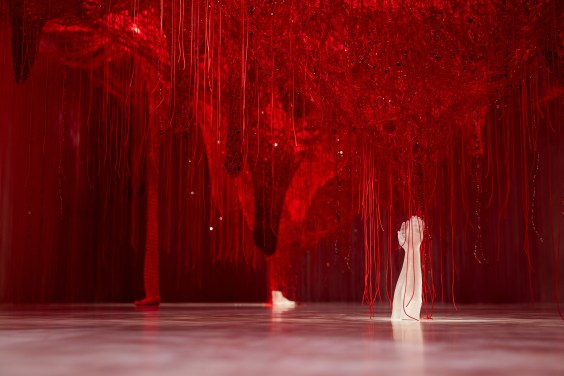
The first time I consciously contemplated a museum’s installation-specific smell was in Fernando Romero’s “El Sol” at Kristallwelten in Innsbruck, Austria. Viewers stand in a cave-like, red-lit room under a Swarovski crystal sphere exactly one-billionth the size of the sun. It even sounds like the sun—the University of Birmingham’s School of Physics and Astronomy spent 30 years recording solar acoustic wave data, which has been sped up about 100,000 times to create the installation’s soundscape.
Standing in the room is somehow both soothing and disconcerting. If you don’t read the informational display or listen to the audio tour, you might feel like you’re just standing under a particularly fancy disco ball, listening to a higher-pitched edit of dry wind across an empty plain. But it was the scent of the room that struck me: a blend of thyme, black juniper, moss, and gunpowder, inching the red cave toward the realm of the uncanny with the combination of color, sound, and scent, making it easy to envision yourself in the isolation of space or a very high-concept haunted house where that staticky pulsing wind might start saying your name.
Many of Kristallwelten’s other rooms (Chambers of Wonder, as they call them) have scent concepts as well, though less distinct. The rooms smell pleasant, usually lightly herbaceous. There’s a lot of pine and mint to go with all that glittering crystal. It makes sense for a museum that’s essentially a very lovely Swarovski advertisement.