Newsletter Subscribe
Enter your email address below and subscribe to our newsletter

Enter your email address below and subscribe to our newsletter

If you’ve read Nicholas Russell, here or elsewhere, you’ve gathered that he is thoughtful, erudite, and extremely curious. In addition to approximately one million reviews and essays here at Defector, he’s published more than a dozen interviews, and they’ve ranged all over: politics podcasters, a film critic, an indie musician, a veteran foreign correspondent, a cruciverbalist, an English professor and Toni Morrison scholar, and the retired WNBA journeywoman Carolyn Swords. By now, you have probably also picked up on the fact that he is uncommonly driven. Reporting is hard. Interviewing, or at least doing it well, is hard. Freelancing is hard as hell. Russell churns out excellent freelance work while holding down a day job as a bookseller, in addition to writing short fiction.
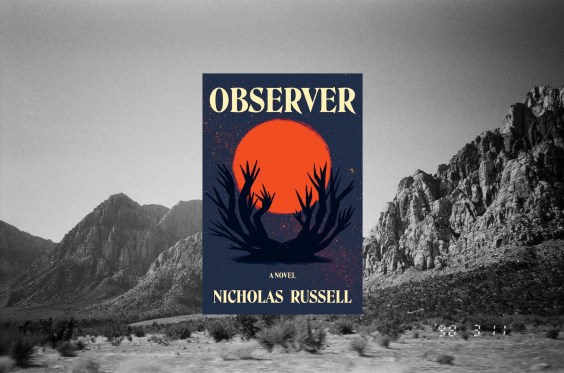
Now he is also a published novelist. Here’s something else you might’ve noticed from reading Russell’s stuff: He is a bit of a horror sicko. His novel, Observer, which will pop up soon in the horror section of your coolest local bookstore, is what you get from a thoughtful, erudite, extremely curious, and uncommonly driven horror sicko. Set largely in the remote Nevada desert, Observer charts in overlapping timelines human encounters with some deeply weird phenomena and menacing non-human lifeforms. In the 1990s, an emotionally remote and difficult scientist named Corinne arrives at an astronomical observatory in the outpost town of McNairy and witnesses up close the shocking and calamitous destruction of the facility and its various projects. In the present, Corinne has disappeared and is presumed dead, and her estranged adult daughter, Renata, takes possession of a chaotic trove of Corinne’s possessions. Renata begins from that mess to work toward an understanding of this enigmatic void of a parental figure. And both Corinne and Renata endeavor to make heads or tails of the writings of Francis Brown, an early 20th-century prospector whose journal entries describe the discovery, in the depths of an unexplored desert cave, of something impossible.
Observer is a couple of different kinds of mystery: Its characters are groping around for comprehension, both of the disaster and wreckage above McNairy and of one another, but Russell is disciplined in his doling out of information, resisting the temptation to swoop down with huge blundering author hands and scratch clues into tree-trunks and so forth. Remoteness, that specific gritty and standoffish remoteness of desert habitations, is so essential to Observer‘s narrative that it might as well be a named character; if it’s hard and thorny to reconstruct a complete understanding of some of the most spectacular and studied disasters of modern history, imagine trying it in a forgotten and decaying Southwestern town where everyone, human or otherwise, wants to be left the hell alone. It’s a real strength of the novel. You can go in some pretty surprising directions if you set your story in a place where eons might plausibly pass without this or that creek, canyon, or cave getting a very close human inspection.