Newsletter Subscribe
Enter your email address below and subscribe to our newsletter

Enter your email address below and subscribe to our newsletter



There’s no denying that digital and social media have only amplified the identity politics, erosion of trust and geopolitical shifts that have polarized mankind this century. New polling by the Association for Canadian Studies shows that polarization is emerging at the interpersonal level.
More than twice as many Canadians (52 per cent) think it’s getting harder and harder for people with differing opinions “on major international conflicts to remain friends” than those who feel it’s not more difficult (21 per cent).
“These issues are increasingly divisive and polarizing,” Association for Canadian Studies president Jack Jedwab told National Post in an interview.
More than a quarter (27 per cent) are unsure, a feeling expressed by a third of women (33 per cent) and close to a third of the oldest demographics — 55-65 (32 per cent) and 65-plus (31 per cent).
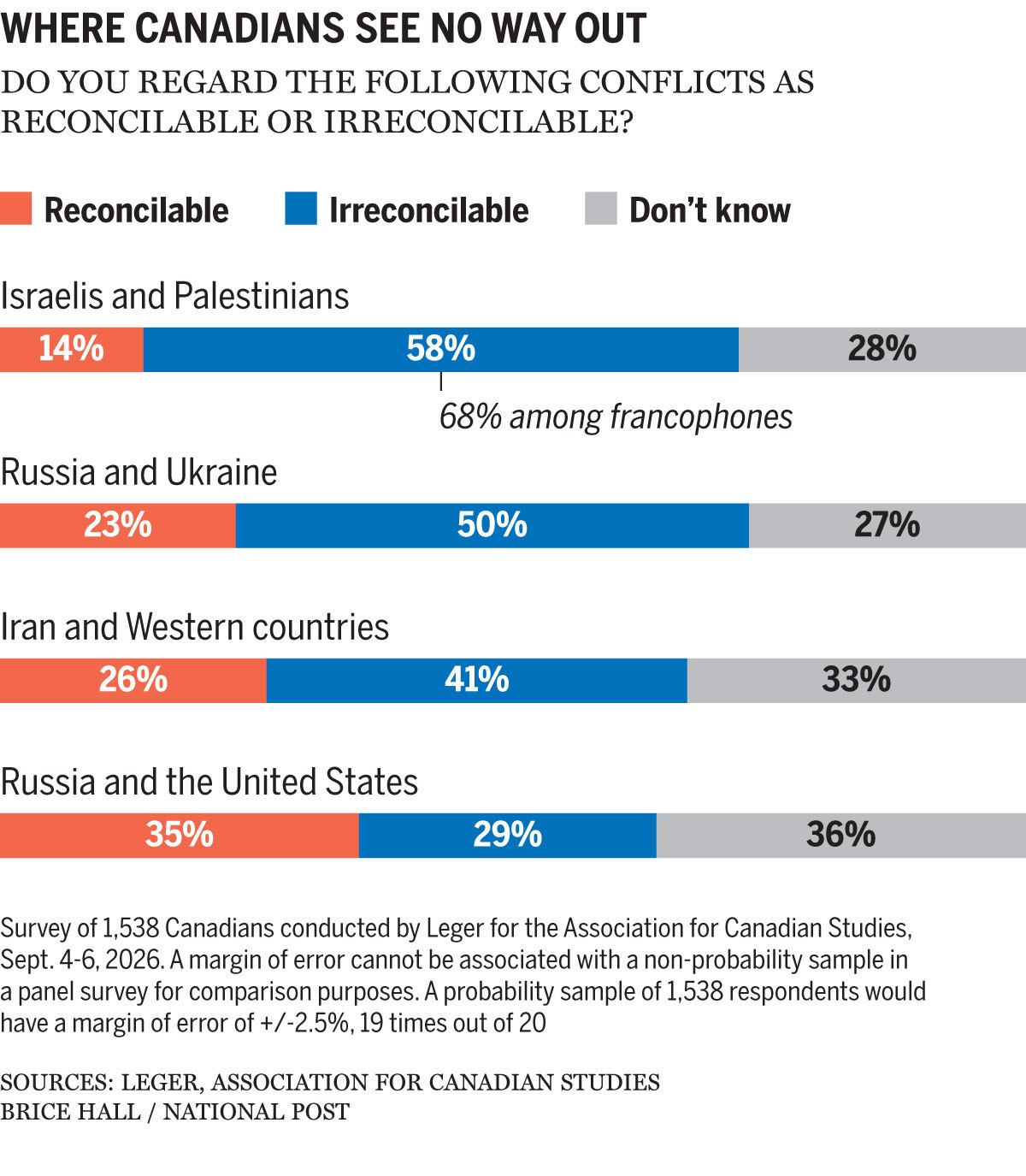
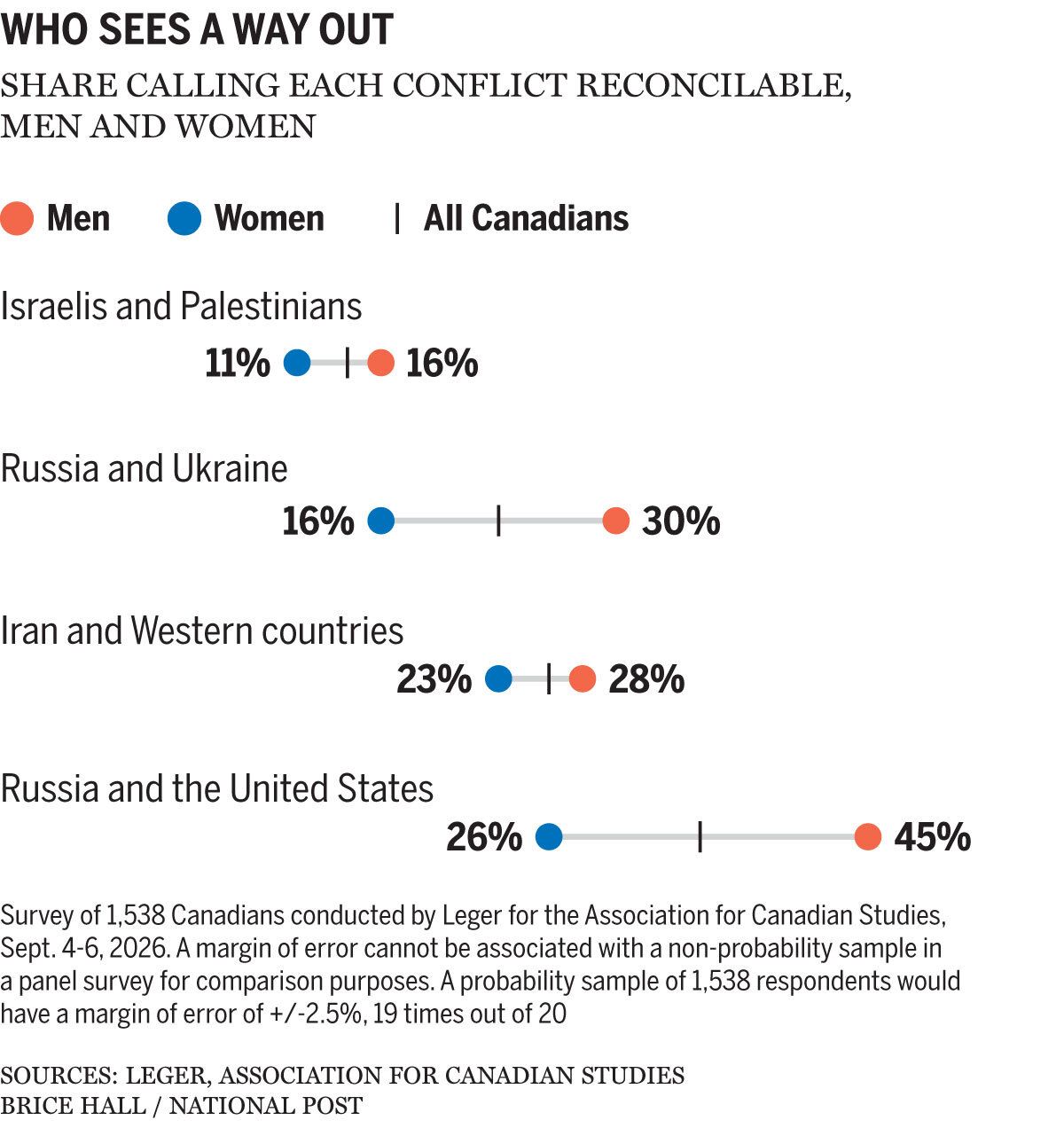
Respondents were asked about the reconcilability of four conflicts — Russia and Ukraine; Russia and the U.S.; Iran and Western countries; and Israelis and Palestinians.
It didn’t surprise Jedwab then that the latter conflict emerged as the least reconcilable (14 per cent) among respondents.
 “The polarity is probably confirmed by the fact that very few people think it’s reconcilable, which is interesting, because you do hear from many people that seem to, in their own sort of spaces, feel that these issues can be reconciled if both parties would do this or that,” Jedwab told National Post in an interview.
“So if you think that’s the case, one can only imagine how challenging it is for reconciliation with people who are living the experience on the ground where they happen to be, in this particular case, the Middle East.”
Only the mostly dormant Russia-U.S. conflict is seen as more reconcilable (35 per cent) than not (29 per cent), but the largest percentage (36) are unsure.
Polling found a consistent pattern regardless of respondents’ language, whether anglophone, francophone or allophone, “suggesting that the polarizing effects of international conflicts cross linguistic boundaries,” Jedwab wrote in the poll.
That consistency is “something that we can all build as a consensus around the extent to which this thing is divisive,” he added in conversation.
Reducing polarization, he said, begins with “thoughtful” conversations about complex subjects that involve the realities of the people on the ground for whom reconciliation is most difficult and for whom the situation is evolving.
“We need to sort of identify parameters for how these conversations can be done in the most thoughtful way possible, recognizing that… many of us, even though we may have disproportionate degrees of connections to what’s going on there, we still need to engage and find thoughtful ways of engaging in dialogue.”
The poll of 1,538 respondents, conducted by Leger on behalf of the Association for Canadian Studies, was conducted Sept. 4-6. A margin of error cannot be associated with a non-probability sample in a panel survey for comparison purposes. However, a probability sample of this size would have a margin of error of 2.5 per cent, 19 times out of 20.
Our website is the place for the latest breaking news, exclusive scoops, longreads and provocative commentary. Please bookmark nationalpost.com and sign up for our newsletters here.