Newsletter Subscribe
Enter your email address below and subscribe to our newsletter

Enter your email address below and subscribe to our newsletter


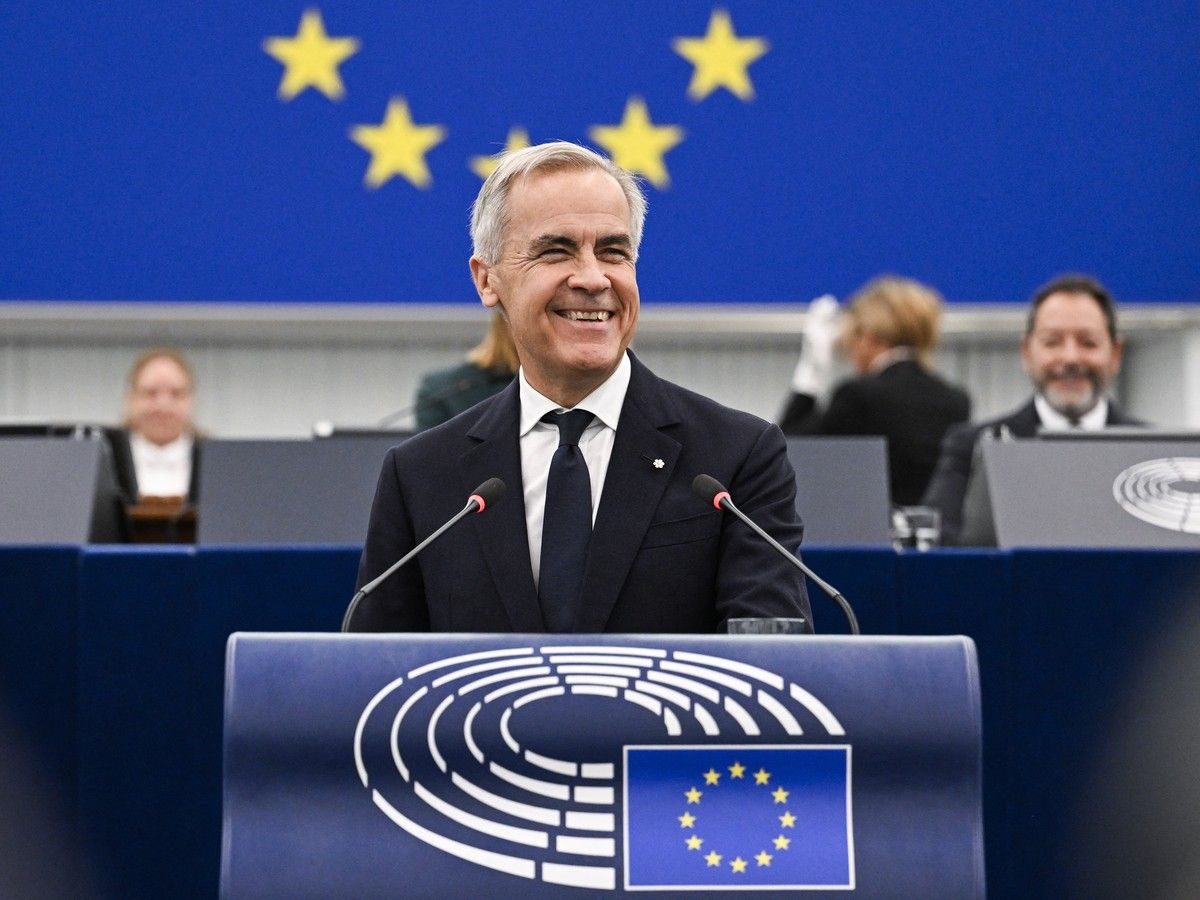
WASHINGTON, D.C. — Prime Minister Mark Carney has explained his push for a closer relationship with Europe in simple terms.
“Developing an alliance for the future with the European Union … is based on Canada becoming more sovereign,” he said last week at a press conference on the sidelines of the UN General Assembly.
Last week, European Commission President Ursula von der Leyen proposed that Canada could become the European Union’s first “associate member,” drawing cheers, some confusion, and jeers from both sides of the Atlantic. U.S. President Donald Trump went further, saying he could see it as a “hostile act” if it were pursued with “bad intention,” and warning he could impose steep tariffs or even curb trade with Europe.
But what about Canada? With trade talks having collapsed in August, leading to more tariffs on both sides, how might Washington respond to Canada’s true north pointing further east — as a legitimate hedge or a challenge to U.S. power?
In a recent interview, Ambassador Pete Hoekstra shared his thoughts, noting that the preliminary trade agreement between the U.S. and Canada can no longer be the starting point for future talks. He said too much had changed in just three and a half weeks, including the EU proposal. Hoekstra offered a possible response that would have significant implications for the Canada-U.S.-Mexico Agreement and U.S.-Canada trade.
“I’ve talked with our trade negotiators, and they said, ‘Well, that may just kind of simplify things, because we have a trade agreement with the EU. We may just slide Canada in under the EU trade agreement. We won’t treat Canada as a country with whom we have a four- or five-thousand-mile border anymore. Canada has made its decision. It is aligning with the EU, so it only makes sense for the U.S. to put Canada under that trade agreement,’” he said.
Washington, in other words, could seek to apply the 15 per cent tariff ceiling imposed on most EU exports.
Hoekstra’s office declined National Post’s request to comment on the matter.
“Don’t take it seriously,” said Richard Stern, the vice president of the Plymouth Institute for Free Enterprise at Advancing American Freedom, a Washington-based conservative think tank.
“(Hoekstra) is trying to be the pitbull — the voice of people who are trying to stir up trouble, who are trying to separate America and Canada, who are trying to separate America from our closest allies.”
The suggestion that Canada could be folded into a U.S.-EU tariff framework, Stern said, is not a legal path for displacing CUSMA.
“There’s no real legal theory on that,” he said.
Alfredo Carrillo Obregon, a trade policy analyst at the Cato Institute, agreed. He said Article 32.10 — CUSMA’s “non-market-country FTA” clause — is the only provision that allows the other two CUSMA parties to terminate the agreement if one member signs a free-trade agreement with a qualifying non-market economy. But he said it would not apply to a Canadian arrangement with the EU.
“The clause about negotiations with non-market economies … was written with China in mind. I don’t think you could mold it to fit the European Union,” he said.
Gary Clyde Hufbauer, senior fellow at the Peterson Institute for International Economics, also said CUSMA contains no provision that would allow Trump to deny Canadian goods preferential treatment just because Ottawa forges closer ties with Brussels.
But that also may not matter, he noted.
“Trump doesn’t care about previous agreements, even ones he’s written,” Hufbauer warned. “He can just override it with the next executive order citing some statute.”
So what might Trump see as a provocation?
“It’s really whatever Trump would seem to see as hostile,” said Jamie Tronnes, executive director of the Center for North American Prosperity and Security.
“Anything to do with the EU gets their back up.”
Obregon agreed that the scope is broad.
“It could be something as simple as granting European products favourable access to, or more favourable access to, the Canadian market than they have right now under CETA,” he said, noting that the U.S. administration might label it discriminatory and try invoking more Section 338 tariffs in response.
Hufbauer believes Canada could go too far if it aligns its standards more closely with European regulations, creating new barriers to U.S. exporters.
“Standards become quite important. They’re a tariff substitute. It’s as simple as that,” Hufbauer said, noting that Section 232 tariffs would be the easiest tool at Trump’s disposal.
Any attempt to invoke CUSMA’s non-market-country provisions against Canada over its ties with Europe would almost certainly face a legal challenge. Stern said that argument would fail in court.
“No serious court in the United States would let the president penalize Canada for working with the EU by classifying the EU as representing a non-market economy,” he said.
Still, court fights would not resolve Canada’s immediate need to reduce its exposure to U.S. dependence. Legal limits on U.S. action also can’t alleviate the uncertainty that Trump’s tariff threats create for Canadian businesses and leaders.
This brings us back to Carney’s rationale for pursuing closer EU ties in the first place: the need to reduce Canada’s exposure to unpredictable U.S. trade policy.
“More than improving Canada’s negotiating position,” Obregon said, “I would think about it more as hedging against the risk that comes with having a more protectionist mind in the White House.”
National Post
Our website is the place for the latest breaking news, exclusive scoops, longreads and provocative commentary. Please bookmark nationalpost.com and sign up for our newsletters here.