Newsletter Subscribe
Enter your email address below and subscribe to our newsletter

Enter your email address below and subscribe to our newsletter


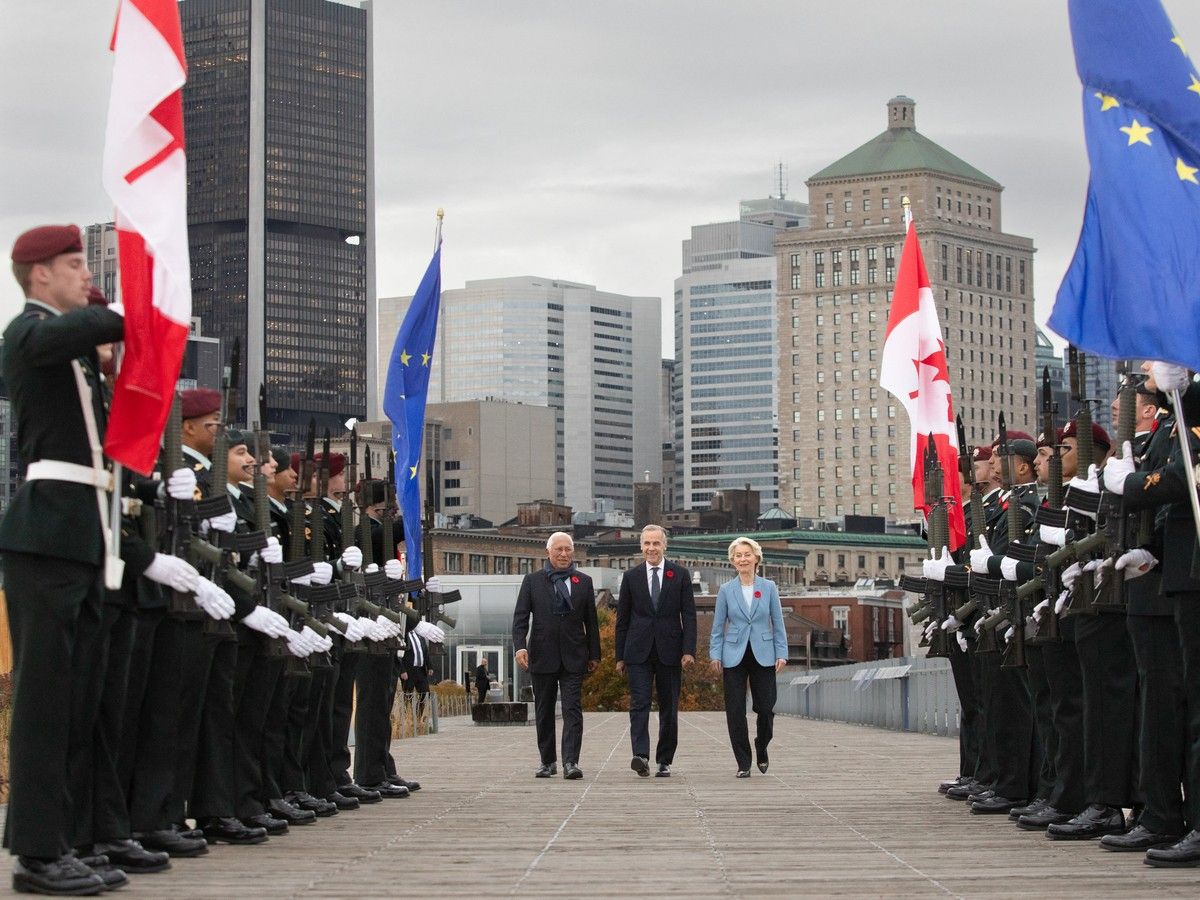
MONTREAL — Canada will become the European Unions’ first ever “associate member” as both parties announced a new alliance to deepen integration and address trade irritants.
This initiative unveiled on Friday, on the second day of the Canada-EU summit in Montreal, promises to boost cross-border movement of goods and people, drop trade barriers and create jobs on both continents.
“What is the advantage for the people? Rightly so, it’s jobs first and foremost, good jobs,” European Commission President Ursula von der Leyen said during a press conference with Prime Minister Mark Carney and European Council President Antonio Costa.
Carney added that the alliance would help lower the cost of goods, travel and studying in the EU for Canadians and would create more competition in the financial sector.
“It won’t be necessary to go to Europe to see the benefits of this partnership,” he added.
The summit on Friday served to launch formal talks to define what becoming an “associate member” really means, as the status does not currently exist in EU rules. Both von der Leyen and Carny said the full terms would be hammered out by next June.
“In the coming months, we will determine the full substance, scale, and scope of this new form of membership,” Carney said.
The prime minister also said that Canada and the EU had fixed certain trade irritants that are set to impose costs and heavy compliance requirements on Canadian imports in 2027, such as the EU’s carbon border levy and its anti-deforestation law.
But the prime minister didn’t provide any details as to how the issues were resolved. In a background briefing for reporters after the announcement, senior government officials walked back his statement, instead saying a deal was “very, very close”.
“Over the past few days, weeks, there’s been great progress among our officials on trying to get rid of these these irritants,” said one official, who spoke on the condition they were not named.
Friday, both parties agreed to deepen integration in fields such as trade and regulatory cooperation; digital, research and communications technologies; critical raw materials and energy; financial services and markets; security and preparedness, as well as people-to-people relations.
A major piece for students and universities will be Canada’s joining of Erasmus+, the EU’s flagship 26.2 billion Euro student mobility and exchange program.
“Through this program, a Canadian student can pursue their studies in Barcelona just as easily as they could at McGill,” Carney said.
“It means an apprentice welder in Manitoba can bring and complete their placement with an employer in Italy, bringing new skills back home,” he added.
A joint declaration published Friday says that the “Alliance for the Future” will based on the “principle of reciprocity in industrial sectors” and that it will be anchored in “a more active foreign and security policy partnership.”
During the press conference, Carney declined to detail the cost of admission into associate membership, nor if or how much Canada would pay in to the programs its joining.
Instead, he argued that the alliance would create new synergies that would generate far more value than any potential costs.
“This is about coming together. One plus one equals more than two, it’s called a synergy,” he said.
Another major piece of the deal is Canada’s intent to join the next edition of Horizon, the flagship EU research and innovation funding program. Canada joined an earlier iteration of the program in 2024.
Friday, the two allies signed a new Digital Trade Agreement, which von der Leyen described as the “digital arm” of the existing Canada-EU free trade deal.
They also ratified a deal that allows Canadian researchers to access Europe’s twelve supercomputers.
Last month, Carney promised that the final deal would be debated in Parliament and put to a vote.
Friday, the officials speaking on background suggested there would not be any legislation forthcoming regarding Canada’s “associate member” status.
“None of that is something that is baked in legislation, it’s a concept, a signal of closer association, of willingness to develop things together,” one official said.
Following the announcement, Bloc Québécois leader Yves-François Blanchet insisted that the new deal be put to MPs and voted in Parliament once completed.
Our website is the place for the latest breaking news, exclusive scoops, longreads and provocative commentary. Please bookmark nationalpost.com and sign up for our newsletters here.