Newsletter Subscribe
Enter your email address below and subscribe to our newsletter

Enter your email address below and subscribe to our newsletter

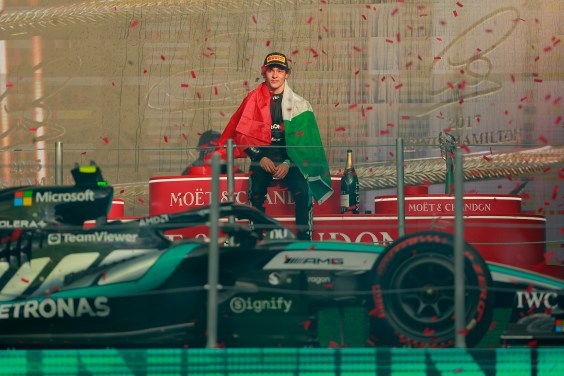
This year, Kimi Antonelli got lucky. Antonelli drives the fastest car on the grid. He is young—very recently a teenager, even; he turned 20 in August—and that means, when faced with an entirely new and controversial ruleset, he didn’t have years of prior programming to overcome. And despite his youth, Antonelli has a good sense of narrative satisfaction. This Sunday, during the Mexican Grand Prix, he made sure to snag a podium place in the race where he became the youngest ever Formula 1 driver to win a Drivers Championship, hoisted in celebration by the generational superstars before him. Past, present, future.
It was the third iteration of an Antonelli–Max Verstappen–Lewis Hamilton podium this year. When the podium roster first occurred in Canada, still early in the season, it was already tempting to refer to the moment as legendary: Antonelli was riding a four-race win streak, and led his much more experienced teammate, George Russell, by 43 points in the championship. But last year proved that inexperienced winners can lose championships even after being staked to larger, later leads, and Antonelli is as inexperienced as it gets, while Russell was getting unlucky with engine failures and mechanical issues. Antonelli had a substantial slump in form over the summer the previous year as a rookie, after a string of good performances to start the season. Over the same stretch of the calendar this year, Antonelli suffered two engine failures from strong positions and otherwise earned a podium. Put aside those two engine failures, and so far this season, the only other race in which he did not finish on the podium was the Azerbaijan Grand Prix, where he finished P5.
Formula 1 is a sport in which it is notoriously difficult to distinguish generational talents by their skill rather than by their results. Even the greatest drivers of all time cannot overcome massive gaps in machinery. Even a generational driver will need the correct team, the correct car, the correct regulations, the correct teammate, the correct timing; a generational driver must deliver several seasons of consistent results to prove their standing. But last year provided a timely example of what it looks like when two merely very good drivers, matched in their very-goodness, are given a rocketship to guide to a championship: a close but not particularly exciting battle marked more by ass–over–heels fumbling and obnoxious team orders than iconic victories.