
Newsletter Subscribe
Enter your email address below and subscribe to our newsletter

Enter your email address below and subscribe to our newsletter

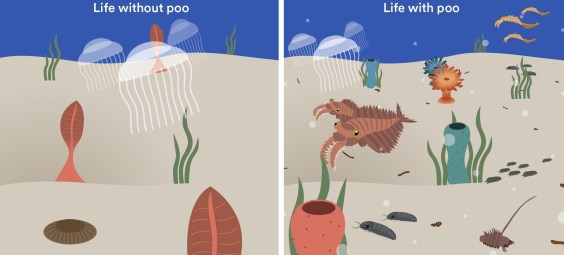
Julien Kimmig’s career began with a surprising abundance of feces. As a PhD student working at a Cambrian site in northern Canada, Kimmig realized that roughly half the fossils in that outcrop were coprolites, or fossilized poops. Kimmig, now the head of the paleontology and evolution division at the Natural History Museum in Karlsruhe, Germany, wondered what explained the deluge of dung.
In 2020, Russell Bicknell, an evolutionary biologist and paleobiologist at Flinders University in Adelaide, approached Kimmig with some Cambrian coprolites from southern Australia that no other scientists had particularly cared to study. Prehistoric poops in hand, Kimmig and Bicknell began compiling a database of the earliest evidence of turds on Earth. The project occasionally stalled, but the researchers eventually picked up on a pattern. In the early Cambrian period, around 538 million years ago, all droppings were microscopic. By the middle Cambrian, scat was finally visible to the naked eye, and it came in a cornucopia of forms: spheres, ellipses, pellets, cylinders, and the intriguingly named “exploded fecal carpets.” The researchers realized this coincided with the development of animal guts. The fancier the gut, the fancier (and bigger) the poop. After tossing ideas around, they hit on a thesis: What if the presence of poop enabled early animals to expand into deeper waters, accelerating the evolution of life on Earth?
Kimmig and Bicknell’s paper on what they dub the “Cambrian fecal revolution” was recently published in Trends in Ecology & Evolution. They make the case that as animals got bigger, their poops exploded in possibility, getting larger and more complicated. This positive feedback loop paved the way for species to expand into new territory, diversify, and define modern ecosystems. So stop whatever you’re doing, especially if you’re eating, and enjoy this conversation with Kimmig where we try to get to the bottom of the shit underlying the world as we know it. This interview, conducted this past Wednesday, has been lightly edited for clarity.