Newsletter Subscribe
Enter your email address below and subscribe to our newsletter

Enter your email address below and subscribe to our newsletter

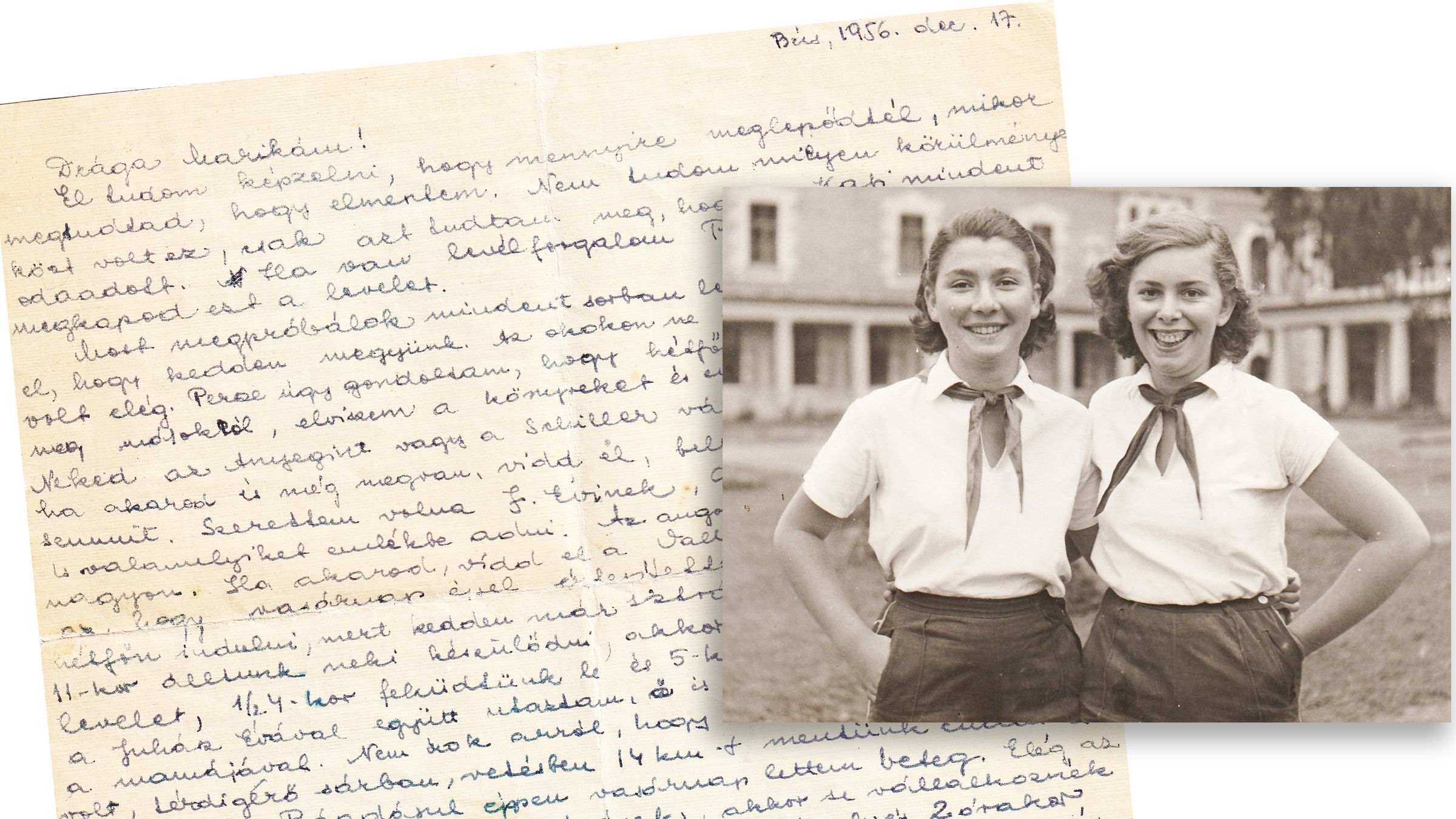
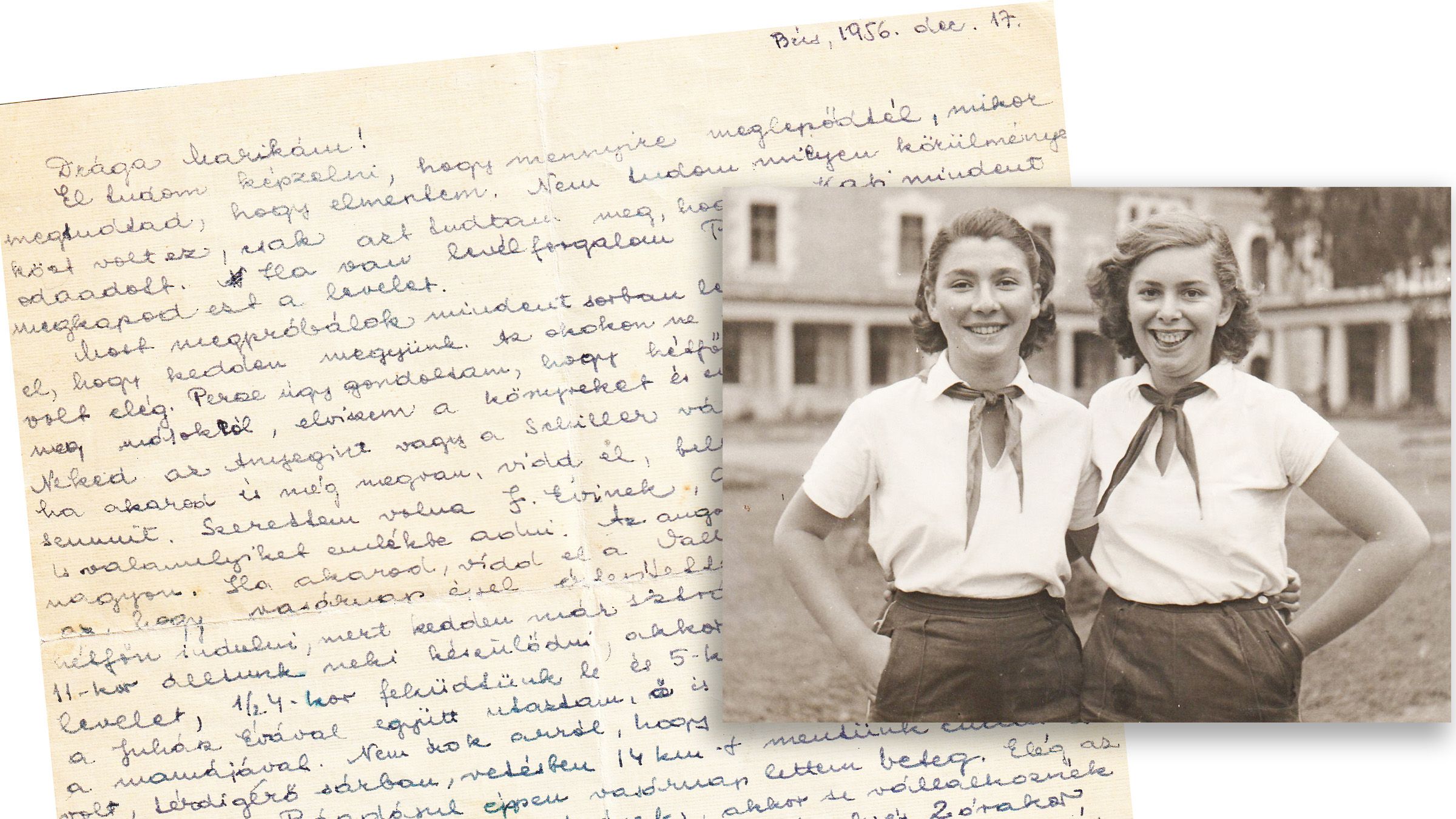
Vienna, 1956 dec. 17
My dear Marika,
I can imagine how surprised you were when you found out that I had left.
I discovered the letter, written in my late mother’s distinctive, minuscule cursive Hungarian, only this year. She must have retrieved it from Mari, her best friend, on one of her many visits back to Budapest over the years. Mom had often spoken about the 1 956 Hungarian Revolution , which had changed the trajectory of her life, but that was in retrospect. This, by contrast, was contemporaneous; a glimpse through her 16-year-old eyes, written just a week after she, with her parents and 10-year-old brother, fled the country, as did some 200,000 Hungarians during and following the short-lived revolution. Planning one’s escape was a secret too risky to be shared, even with your best friend.
* * *
Hungary at the time was a totalitarian Soviet satellite state whose citizens endured political repression and struggled with increasing poverty due to Stalinist economic policies. My family lived in the heart of Budapest’s gritty, working-class 8th district, in an apartment facing Teleki tér (Teleki Square). Nagymama and Nagypapa, as I called my grandparents in Hungarian, were vendors of used goods, mainly Persian carpets, at the local indoor flea market. Frugal by nature and necessity, they nonetheless frequented the cafés for habos kávé (a strong black coffee topped generously with whipped cream) and splurged on English lessons for my teenage mother. When business was slow, Nagypapa would pawn items to make ends meet. A couple of years earlier, state authorities had revoked his vendor permit, forced him to join the Communist party and work in a factory. And because he had a lovely voice, they also forced him to “volunteer” with a workers’ choir that performed patriotic songs for the public. But by now his permit had been restored and he had rejoined my grandmother at their market stall.
My mother, meanwhile, was a stellar student, with dreams of becoming a chemist. Much of her time was spent in uniform with the Young Pioneers, the mandatory state-run Communist youth organization. Thanks to her time in “commie camp,” as she’d derisively refer to it years later, no matter how much I begged, she adamantly refused during my childhood to enrol me in any uniformed activity such as Girl Guides.
The events that sparked the Hungarian Revolution began mid-afternoon on Oct. 23, 1956, when thousands of college and university students marched peacefully to the Hungarian parliament building, demanding democratic reforms and an end to Soviet occupation. Workers and other supporters joined in, and the exhilarated crowd grew to an estimated 100,000 to 200,000. My mother, in her last year of high school, marched with the students, but had to leave early because the family had tickets to a show that evening at the Budapest Operetta Theatre. (The one upside to living under a Communist regime was that classical performances were heavily subsidized, to make them affordable for the masses.)
While my family was at the theatre, a group of protesters branched off and marched to the Hungarian Radio building , where a student delegation entered, requesting that its list of demands be broadcast. Instead, the students were detained by authorities. The crowd outside — chanting anti-regime slogans and demanding the delegation’s release — refused orders to disperse. As tensions escalated, the state secret police, the ÁVH, first deployed tear gas and then, at around 9 p.m., opened fire on the unarmed demonstrators, killing several. (The precise death toll has never been ascertained.) My family heard gunshots as we exited the theatre nearby.
By midnight, Budapest’s statue of Josef Stalin had been toppled, angry crowds raided police stations and military depots for weapons, and an armed uprising had begun. For the next 12 days, bloody battles ensued between civilian militias — comprised of students, intellectuals, workers and defecting Hungarian soldiers — and the ÁVH and Soviet soldiers already stationed in Hungary. Then, on Nov. 4, the Soviet Red Army invaded with thousands of troops and tanks, crushing the revolt in a week.
Some of the most intense battles occurred in the 8th district because two revolutionary groups were based there. The rebels used the apartment buildings lining Teleki Square and the surrounding streets — home to my family and all our relatives — to ambush Soviet tanks with Molotov cocktails. In response, the neighbourhood’s residential buildings were the target of intense Soviet shelling.
Mom and her family spent many nights sheltering in their building’s cellar during bombardments, sleeping on piles of coal. The building took three direct hits, one of which took out most of a neighbour’s apartment. Soviet troops machine-gunned the building, leaving a line of bullet holes trailing across the top of my family’s living room wall, which had recently been painted aqua blue and stencilled with small yellow flowers. At one point, Mom’s kid brother excitedly peered out their apartment window to watch the Red Army tanks and Nagymama frantically yanked him back; a Russian soldier on the lookout for snipers had narrowly missed shooting their downstairs neighbour who had peeked out his window the night before. Forever etched in my mother’s memory was the sight of a dead body lying at their building entrance.
Yet what led Nagymama and Nagypapa, then 41 and 47 respectively, to flee the country — which had been home to our family since the 1700s, at least — wasn’t this. It was a singular event on a streetcar.
Before the Soviet invasion, on the morning of Oct. 30 — in retaliation for the radio building massacre and “Bloody Thursday,” a worse massacre outside parliament two days later in which ÁVH snipers and Soviet tanks fired on the unarmed demonstrators, killing as many as 1,000 — an angry crowd laid siege to the Budapest Communist party Headquarters on Republic Square, which was just 750 metres or so from Teleki Square. By afternoon, the headquarters fell, and the rebels captured several secret police officers and Communist party officials, brutally tortured them to death, and hanged their bodies upside-down from trees.
A couple of days later, my grandparents took advantage of a lull in the fighting to go shopping for essentials. As they were returning home by streetcar, they passed by the lynched corpses, which had not yet been removed. The streetcar conductress, upon seeing the gruesome scene, proclaimed loudly and approvingly to the passengers, “And after we finish with them, we’ll finally finish off the Jews!”
These events of 1956 were occurring a mere 11 years after the end of the Second World War, during which the Nazis, with the enthusiastic collaboration of the Hungarian Arrow Cross Fascists, murdered 565,000 Hungarian Jews, 70 per cent of the country’s Jewish population. Since 1939, upwards of 100,000 Jewish men between the ages of 18 and 48 had been conscripted into forced labour where they were subjected to abuse, starvation, disease and executions. Nearly half did not survive, including three of Nagypapa’s five brothers, four of Nagymama’s sisters’ husbands and her nephew. When Nagypapa, a tall, stocky man, arrived home from Bor, one of the worst of the slave labour camps, he was a walking skeleton, weighing only 41 kilograms (90 lbs).
The deportation of 450,000 Hungarian Jews to Auschwitz began after the Germans invaded Hungary in March of 1944. Those not deported — including my grandmother and her five sisters — were forced into the Budapest ghetto, the 0.25 sq.-km (0.1 sq.-mile) zone into which 75,000 Jews had been herded after the Nazi-aligned Arrow Cross took power in October of 1944. No food was allowed in, waste went uncollected, typhoid was rampant, and thousands of dead Jews piled up in the streets. During that same period, Arrow Cross militiamen shot 10,000 to 20,000 Budapest Jews along the banks of the Danube River and forced tens of thousands of Jews onto death marches for hundreds of miles toward concentration camps. Nagymama had been literally grabbed on the streets of the ghetto and thrown into one such death march, but, miraculously, after a couple of days of walking, two complete strangers sneaked her out of the crowd and accompanied her by train back to Budapest. To her dying day, she never knew who those men were, nor why they chose to save her.
When the Jews were ordered into the ghetto, Nagymama hid my four-year-old mother with nuns. At war’s end, she found her daughter barely alive, gravely ill with scarlet fever. She held her mirror compact up to my mother’s mouth, to see if she was still breathing.
* * *
Given that all this was fairly recent history in 1956, it’s hardly surprising that, on the streetcar, Nagymama had what today we would recognize as a PTSD response. She completely lost it, shrieking hysterically at the conductress, “Shame on you! You have blood on your hands!” My grandfather, noting no sympathetic glances from fellow passengers, dragged my screaming grandmother off the streetcar at the next stop. That’s when she told my grandfather in no uncertain terms that they were not sticking around for another genocide.
The Soviet invasion five days later to crush the revolution — again, cue the PTSD — cemented that decision to leave. When the Red Army had liberated Budapest in 1945, it raped its way through the city. That the women of our family were among the victims of this rampage was something alluded to but never spoken of. My mother had told me that the reason why two of my grandmother’s sisters were childless was that they had back-alley abortions “during wartime” which left them sterile. What Nagymama did describe to me was the rape prevention tactic she devised when she walked the streets of liberated Budapest to locate my mother: she spread dirt on her face and wrapped herself in a shawl, disguising her 30-year-old self as an old lady.
Suffice it to say that my grandparents weren’t keen to stick around for another Soviet occupation either.
Upon deciding to escape, Nagymama and Nagypapa spent the next month discreetly selling off what they could at a pawnshop to raise the cash needed to pay a smuggler. Finally, on Sunday, Dec. 9, they set the departure date for the coming Tuesday. Then, news of an imminent train strike derailed that timetable.
We decided on Sunday that we would go on Tuesday. Don’t worry too much about the reasons, there were plenty. Of course, I thought that on Monday I would say goodbye to you and others and take a couple of books as a souvenir … I am very regretful about (not taking) the English Hamlet …
So, the point is that they woke me up on Sunday night that we had to leave on Monday because there would be a strike on Tuesday.
Before the uprising had been crushed — that is, from late October to early November — the border had been effectively unpoliced due to the collapse of the secret police, Hungarian military defections, and revolution-sympathetic border guards turning a blind eye. More than 180,000 Hungarians fled to Austria in broad daylight during this window of opportunity. Then, that window slammed shut with the Soviet invasion of Nov. 4. The border was immediately sealed, fortified with landmines and tripwires, and heavily guarded by Soviet tanks and armed patrols. If caught trying to cross, you could be shot on sight.
Soviet soldiers, Hungarian secret police, and Communist authorities now patrolled railway platforms, looking for people setting out to flee, an act which was considered treason against the State. If caught, you could face lengthy imprisonment in harsh conditions. Upon release, you and your family would be blacklisted, effectively barring access to higher education, housing and certain types of employment. If you were a suspected revolutionary, even worse: interrogation, torture and, if deemed guilty, execution by hanging.
So, escaping this late in the game required utmost secrecy and caution. That meant having a ready alibi to explain why you were travelling by train to a destination in the western part of the country. That meant travelling in a nice outfit, not clothing that might suggest a rugged journey ahead. That meant not carrying more than one suitcase, because, after all, you were just taking a few days’ vacation or visiting a sick relative.
Imagine we started getting ready at 11 at night … and we woke up at 5:00 …
On the day of departure, my family grabbed a cab at Teleki Square to Keleti Railway Station. On the train, they deliberately sat separately from Nagymama’s sister and her family, who were also escaping. They disembarked at a small town, not the last stop before the border because that would have been too obvious. From the station, a horse-drawn farmer’s cart transported my family to a village close to the border, where they were let off at a house. By now, it was dusk. They were led into a bedroom, where a guide soon arrived and told them he’d be back for them when it was pitch-dark. When he returned, he led them to a clearing in the woods, where they joined a group of roughly 40 people, including our relatives, who had waited in a different house. Babies were injected with a sedative so that they wouldn’t cry. Then the guides gave this most important instruction: when Soviet watchtowers sweep the area with spotlights, or light up the sky with flares, dive flat onto the ground. (Being early December, the ground was hard, frozen farmer’s field in some places, and wet, muddy marsh and peat bog in others.) Then they began walking.
I won’t write about how difficult the walk was, in knee-deep mud, in the field we walked 14 km with our stuff and children … Suffice it to say that if they paid me, I wouldn’t even undertake that trip again … We left Monday at 8:30 a.m. and we arrived 2 a.m. in Austria. We didn’t meet a single soul on the way; they just fired rockets all the time.
The guides had strictly forbidden smoking cigarettes, lest a patrol spot a tiny glow in the dark. This was no small ask of 1950s Hungarians, for whom chain-smoking was a national pastime. Nagymama told me she knew they had finally made it safely across the border when everyone (by now surely in acute nicotine withdrawal) got the OK to light up.
Somehow, throughout my upbringing, perhaps due to the healing properties of time, geographic distance, and a better life in Canada — or perhaps because the Revolution paled by comparison to the Holocaust — our family’s escape, as recounted by my mother and grandmother, was reduced to a series of amusing vignettes:
Yes, being seen on the train platform with more than one suitcase might arouse suspicion, but my mom, a fashion-obsessed teenage girl, decided that it was a risk she was willing to take. God knows why my grandparents indulged her in this — guilt for tearing her away from all her friends, perhaps? — but she crammed her precious wardrobe into two suitcases. “She was struggling through the fields for hours lugging those two heavy suitcases,” Nagymama would recount, laughing. “We kept pleading with her, ‘Jutka, throw one away!’ But she stubbornly refused. ‘No, I’m not leaving without my clothes!’” At this point, Mom would jump in, feigning vindication: “Meanwhile, it was well worth it. When spring arrived, out came my navy-blue linen suit and matching pumps. I was the best-dressed refugee on the ship!”
Upon finally crossing the Austrian farmland border, the group collapsed in sheer exhaustion against haystacks. Someone handed the men bottles of booze. Whether in celebration or relief, Nagypapa got so drunk that he began yelling, “Taxi! Taxi!” Nagymama would act this out, complete with the taxi-hailing motion, while also assuring me that this was the only time he got drunk. In the absence of said taxi service, they loaded the inebriated men, along with the children, onto a farmer’s cart, and hauled them to the refugee reception centre.
They took us straight to the Red Cross. At that point, I wanted to bang my head against the wall because I didn’t know German … Luckily there were three American men there and I was able to talk (English) to them. They took us from that small village to Andau … where we stayed for 2 days, then for 1 day in Eisenstadt (where Haydn also lived).
On Dec. 13, they arrived in Vienna, with just US$100 to their name, so my grandmother sold her engagement and wedding rings. The American Joint Distribution Committee (AJDC) gave them meal vouchers and put them up at the Wien Hotel on Mariahilfer strasse, where, a few days later, from Room 56, my mother wrote Mari to explain her sudden disappearance, and describe life outside the Iron Curtain:
My dear Marika, … It’s impossible to describe in words what it’s like. These buildings, statues, shop windows! The shops are so tasteful, they have such amazing things. Of course, not in relation to our current financial situation, but in relation to the wages here. The women dress beautifully; stilettos are the norm day and night.
The hat fashion is horrible. The people are very nice and polite. Everywhere they kindly give you directions, smile, and they stuff the children with chocolate. You can also get all kinds of citrus fruits cheaply. The delicatessens are so tasteful that they are a joy to look at. Everything is sparkling clean. If someone throws a piece of paper on the street, they tell you to pick it up. Even the train stations are as clean as a pharmacy. The illumination at night is beautiful, especially now, before Christmas …
… The Opera is also performing Turandot and other things that we only heard on the radio at home. I can only see most of them from the outside, because in the Opera, for example, even the cheapest seat is more expensive than the most expensive one in our country …
At this point in time, the main countries taking in Hungarian refugees were the United States, Australia and Canada. My grandparents’ best friends and a nephew, who had escaped earlier, were headed to Montreal, so it was a no-brainer.
Of course, it will be difficult in Canada. They speak English differently there, and French is also an official language …
Three months later, they were on a train to the Netherlands; the country was taking in refugees scheduled to depart on ships from the Port of Rotterdam. During their three-month stay outside the city of Deventer, my grandparents, anxious to resume earning money, got jobs in a local factory, while Mom was paid to teach refugee kids English.
In May 1957, they set sail on the SS Groote Beer for Montreal, where, upon arrival, my now 17-year-old mother descended the gangplank, no doubt fashionably attired in that navy suit and matching shoes.
Nagymama found work in a ballpoint pen factory, Nagypapa as a hospital janitor, showing up for work daily, as he had back home, impeccably dressed in a three-piece suit. Mom, because she spoke English, landed a higher-paying clerical job right away. Nagymama soon learned English well enough to graduate to office jobs (and, ever industrious, continued working well into her 70s).
Shortly after their arrival in Canada, a family friend asked a local Hungarian fellow she knew to show my mother around Montreal. The guy, in his mid-30s, was itching to get out of having to waste an afternoon with some teenager. His buddy, Paul, offered to take her off his hands. That’s how my mother met my father, a Hungarian Holocaust survivor who had arrived in Montreal nearly a decade earlier. They married the next year.
By the time I was born in 1962, Nagypapa had learned how to drive, bought a car, which he kept as spotless as a house with a full-time maid, and, always in a suit, proudly drove arguably the most pristine taxi in Montreal. My paprika-infused childhood was one of Hungarian nursery rhymes and of riding in my grandparents’ car, begging them to turn on the cab meter, after which, as was our routine, they’d jokingly demand payment upon arrival at our destination. We were regularly in the company of their warm, boisterous group of Hungarian émigré friends, including my grandparents’ best friends, a couple who had lived in the same building in Budapest. It was like growing up surrounded by a bunch of Zsa Zsa Gabors , minus the furs and diamonds.
From a very early age, I absorbed from the conversations around me that all family stories fell into two distinct time categories: “before the war” and “after the war” — the war being the Holocaust. My mother had also mentioned on occasion that she had “escaped” Hungary. But until my teen years, I had no understanding of what any of this meant. I just knew that, like my parents’ accents and my ability to speak a foreign language, it made me different from the other Canadian kids.
In 1971, the summer I turned nine, I travelled with my parents to Budapest and met all the relatives who stayed behind, all still living in the same Teleki ter neighbourhood, all in the same apartment building at 46 Népszinhaz utca (street). My great-grandparents first rented Apartment No. 3 back in the 1930s; my grandmother lived there until she married; her sister and family then lived there, along with another sister, until they, too, fled in 1956, after which yet another sister and her family moved in. (That sister’s daughter, my mom’s first cousin, lived there until she moved to another building around the corner just 15 years ago.) The rest of the family resided in Apartment No. 7, first rented in the 1930s by yet another sister, by this point deceased. (That flat, too, stayed in the family, and today is occupied by her great-grandson.)
Being a kid, I was oblivious to the city’s splendour. The memories I took home were of eating raspberry ice cream and langos, a deep-fried flat bread that’s a popular Hungarian street food. I remember bonding with my year-younger second cousin Kati, who now lives in Toronto. I remember the tedium of visiting relative after relative. I vaguely remember meeting Mari during that trip as well.
Over the years in Canada, through on-the-job experience, my sharp-as-a-tack mother acquired accounting skills and eventually worked her way up to a senior position in a large firm, where no one suspected that a revolution had prevented her from even finishing high school, let alone fulfilling her dream of attending university.
In 1996, at just 55 years of age, she died of brain cancer. She had visited Hungary, and seen Mari, numerous times since the escape. That letter of Dec. 17, 1956 — the one written from the hotel room in Vienna — was just the first of many they would exchange throughout her life.
… I’m glad we got out, because now I’m going to learn what it means to fight for existence, to work, and not to settle for the ready-made. I’ve lost a lot of weight from the excitement, but I don’t regret it. Your eyes must be tired of this codex, so I won’t write any more …
We kiss your parents and all the friends.
Many kisses, Jutka
National Post
Main image: Judith Singer, left, and her best friend, Mari, as Young Pioneers in 1954 when they were 14. Also, the Dec. 17, 1956, letter Judith wrote to Mari after her family’s escape from Budapest. Images courtesy Lynn Herzeg