Newsletter Subscribe
Enter your email address below and subscribe to our newsletter

Enter your email address below and subscribe to our newsletter

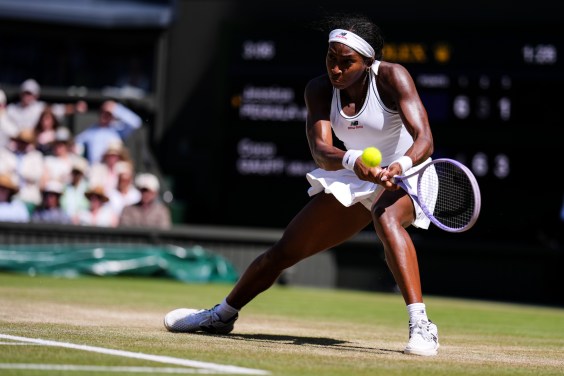
Heading into this year’s Wimbledon, neither Coco Gauff nor Naomi Osaka had made a deep run at the tournament, despite being winning a total of six Slams elsewhere. Gauff had peaked at the fourth round, and Osaka at the third round, three times apiece for both players. An observer trying to make sense of this history could argue that their styles of play weren’t flattered by the demands of grass-court tennis. Osaka’s power game relies on rhythm, which she gets from the ball’s consistent and reliable bounces off a hard court; Gauff’s raw foot speed and rally tolerance aren’t great competitive advantages on a surface where it’s so slippery and difficult to defend.
They weren’t alone in their struggles. For the majority of pro tennis players on both tours, grass appears to be a surface they learn to tolerate rather than one to relish, despite Wimbledon being the most prestigious tournament in the sport. Grass gets a short stint on the calendar, typically just one or two tournaments for most players, and it demands a bit of adaptation. The dominant mode of tennis these players have learned and played all their lives—high-topspin baselining, enabled by polyester strings, fast swings, and explosive lateral movement—are not as viable when the ball’s bounces are so low and unpredictable.
We should celebrate the vanishingly small number of true grass-court specialists out there, those who lean into the surface’s eccentricities and are indeed empowered by them. For example, take the slice-master Tatjana Maria on the women’s side, whose big results on grass—the 2022 Wimbledon semifinals, a Queen’s Club title in 2025—stand stark against her journeywoman career. On the men’s side this year, there was Shintaro Mochizuki, a net-rushing demon who ran from qualifiers all the way to a fourth-round loss to Jannik Sinner, unable to hit any given ball all that hard but able to place every single one on a designated blade of grass. That’s real tennis, and these are real ballers. In an ideal world, grass season would be dominated by players with great hands and that numinous quality called “court sense,” which might be a mix of ball control, anticipation, and pattern recognition. I would accept any amount of tinkering with the parameters of the sport—string bans, ball quality, court speed—to make this style of play viable again. This phase of the tennis season would be a delight.