Newsletter Subscribe
Enter your email address below and subscribe to our newsletter

Enter your email address below and subscribe to our newsletter

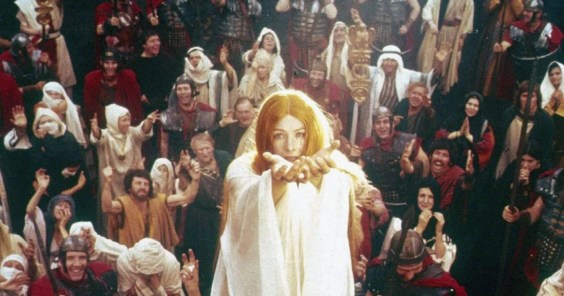
Aldous Huxley likened the exorcism of the prioress Jeanne des Anges to “a rape in a public lavatory.” It was this horrific description that director Ken Russell shared with production designer Derek Jarman before they set out to tell that story. Russell wanted to capture the spirit of Huxley’s nonfiction book, The Devils of Loudun, about the 17th century-incident in which a convent of nuns claimed possession, exhibiting wild and lewd behavior, leading to the sorcery conviction and execution of the priest Urbain Grandier. For that 1971 adaptation, The Devils, Jarman took the assignment quite literally. Large, white tiles cover every inch of Loudun’s Ursuline convent in the film, from floor to wall to arched ceiling. Tiles, and iron bars. It’s a gorgeous set, photographed by cinematographer David Watkin in anamorphic widescreen grandeur, and immerses the audience in the suffocated, cloistered lives of the nuns. Its starkness is at once mesmerizing and maddening. It is the perfect place for a case of possession—or many—and a likely site for clinically staged abuse.
This wasn’t the first time I’d seen the scene in question, which is somehow more and less disturbing than Huxley’s six words suggests. I first watched The Devils some 15 or 20 years ago, on a pirated copy. It was a film whose reputation preceded it, and I was a young guy, barely out of high school, titillated by its scandalous history. Even before it was originally released, The Devils was heavily cut to appease British censors. It was cut further still for its American release. Though it earned respectable sums at the UK box office, the lavish Warner Bros. production received a critical thrashing—Roger Ebert’s sarcastic review is a classic in the genre of getting it completely backwards—and essentially buried thereafter, popping up on a couple of VHS releases in the ’80s, but never on DVD or Blu-ray. In the early ’00s, British film critic Mark Kermode rediscovered the censored footage, helping Russell put together a director’s cut that screened only once, off a DigiBeta tape.
The copy I’d watched years ago was an earlier cut, likely the original theatrical version minus the most controversial scenes, but all that history had me primed for an outrageous film, and an outrageous film is very much what I got. Sister Jeanne’s exorcism—set in that white, tiled lavatory of a convent, molested by priests wielding giant syringes to perform forced enemas—was sensational, as was the rest of the film’s high-toned lunacy. Rampant nudity, violence, actors gesticulating wildly, saying things like, “They say they can stand up to the Church, but they can’t stand up to this bitch.” A movie for sickos. I loved it, naturally, but I don’t think I took it very seriously.